
Part 1 of a 3-part series on governing AI at machine speed
There is no shortage of discussion around AI governance right now.
Frameworks are being developed. Policies are being written. Organisations are actively trying to get ahead of the risks while still capturing the opportunity.
On the surface, it looks like the right response.
But underneath, there is a growing tension.
Most organisations are trying to govern something fundamentally dynamic…
using approaches that are inherently static.
Traditional governance models were designed for environments that were:
- relatively stable
- predictable
- and slow-moving by comparison
They rely on structured processes — policies, procedures, review cycles, audit points — all of which assume that the system being governed behaves in a largely consistent way.
AI does not behave like that.
It evolves.
It adapts.
It is continuously being updated, embedded into new tools, and used in ways that were not anticipated when governance controls were originally defined.
Which creates a simple, but critical problem:
We are trying to govern a machine-speed environment using human-speed processes.
That gap is where risk is emerging.
This is not a criticism of governance itself.
Most organisations already have governance frameworks in place. In many cases, they are well thought through and aligned to recognised standards.
The issue is not the absence of governance.
It’s that governance, as currently applied, is struggling to keep up with the nature of what it is trying to control.
And that raises a more important question:
Is this something that can be solved by refining what we already have… or does it require a shift in how governance operates altogether?
From what I’m seeing across organisations, it’s the latter.
This is less about adding more controls or expanding documentation.
It’s about evolving governance from something that is applied periodically…
to something that operates continuously.
From something static…
to something adaptive.
A Shift Towards AI-Augmented Governance
Rather than replacing existing governance frameworks, what’s beginning to emerge is a different operating model.
One that builds on what organisations already have — but enables it to function at the speed required.
I refer to this as an AI-Augmented Governance Model.
At a high level, it combines:
- clear principles and accountability
- capable human decision-making
- continuous validation of how governance performs in practice
- and the use of AI itself to provide real-time visibility and insight
The model can be visualised as follows:
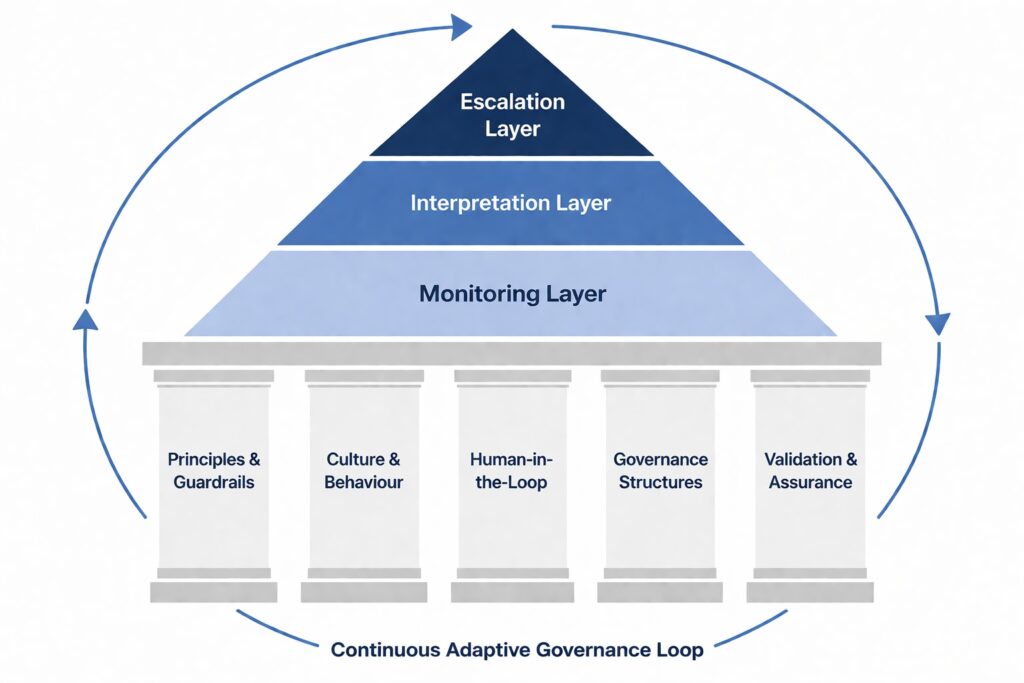
The intent is not to automate governance or remove human judgement.
It is to ensure that governance can operate with sufficient awareness and responsiveness in an environment where conditions are constantly changing.
In practical terms, this means:
- governance is continuously informed by what is happening in real time
- signals are interpreted in context, not just reported
- and where risk or uncertainty emerges, it is escalated to the right people quickly
This represents a shift from governance as a static structure…
to governance as an active system.
Why This Matters Now
Over the next 12–24 months, the gap between organisations is unlikely to be defined by who adopts AI.
Most will.
The difference will be:
who can maintain control and clarity as AI becomes embedded in decision-making and operations.
Those relying purely on static approaches will find it increasingly difficult to:
- maintain visibility
- respond quickly
- and confidently manage emerging risk
Those that evolve their governance models to operate dynamically will be better positioned to manage both risk and opportunity.
What Comes Next
This raises an obvious follow-on question:
If governance needs to operate differently, what capabilities are actually required to support it?
In Part 2, I’ll break down the five core capabilities that underpin this model — and why they are becoming critical for organisations looking to govern AI effectively.